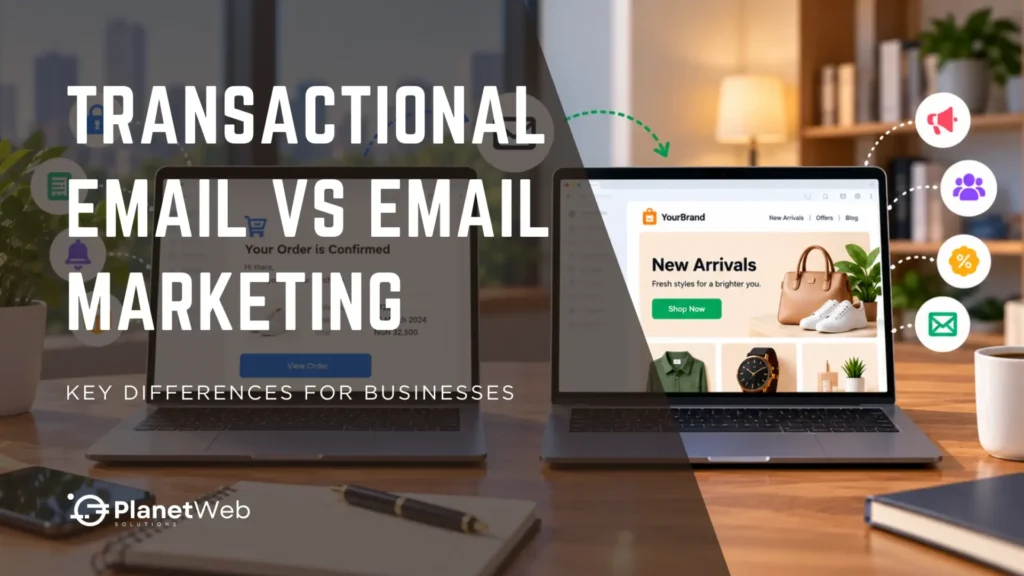
Transactional Email vs Email Marketing: The Difference in Plain Terms
Transactional email is a message sent because a customer did something. A purchase, a password reset request, a booking or a sign-up triggers it, and it goes to that one person. Examples include receipts, order confirmations, one-time passwords and delivery updates. The customer is expecting it, often within seconds, and a late or missing one usually becomes a support call.
Email marketing is a message the business chooses to send, usually to many people at once. Newsletters, promotions, product announcements and re-engagement campaigns all fall into this group. No customer action triggers them, and recipients can reasonably decide they do not want them.
| Transactional Email | Email Marketing | |
|---|---|---|
| Trigger | A customer action | A business decision |
| Purpose | Complete or confirm something the customer did | Promote, inform or keep in touch |
| Typical examples | One-time passwords, password resets, receipts, order confirmations, account notices | Newsletters, promotions, product announcements, abandoned-cart offers |
| Audience | One recipient at a time | A list or segment |
| Recipient expectation | Expected and time-sensitive | Optional and easy to ignore |
| Lawful basis | Usually tied to the customer relationship or a contract | Needs its own basis, and the Nigeria Data Protection Commission’s directive states that consent is required for direct marketing |
| Opt-out | Not normally applicable to the transaction itself | Recipients must be able to object, and unsubscribe requests must be honoured |
| Typical tool | A transactional service connected by SMTP or API | A campaign platform with lists and reporting |
Mixed messages are a common trouble spot, and the test is the purpose and content of the message rather than a simple rule. A receipt can carry information directly related to the purchase, such as the items, the total and the delivery details. A separate promotional offer placed inside it adds a marketing purpose, and that part needs to be considered on its own terms.
Why Each Type Needs Different Tools
Each type of email asks something different of the sending platform.
Transactional email depends on speed and reliability. The system has to fire the moment the application asks for it, one message at a time, and report clearly when something fails. Services built for this connect through SMTP or an API, which is why they suit shops, portals and custom applications. Zoho’s Zeptomail, now part of Zoho CPaaS, is one example, and it handles transactional email only. Zeptomail in Nigeria walks through the setup path, and the ZeptoMail WordPress integration guide covers the WordPress route.
Email marketing depends on different features: list management, segmentation, scheduling, templates, unsubscribe handling and campaign reports that show who opened and who clicked. Zoho Campaigns is an example built for this work. A transactional service lacks these tools and is not meant to carry newsletters or promotions.
What Goes Wrong When the Two Are Mixed
A marketing platform used for transactional mail creates delays and gaps. Campaign platforms are built around scheduled, list-based communication rather than application-triggered events. For password resets and other time-sensitive messages, that mismatch can cause delivery and control problems, and a reset code that arrives late is a failed login. Contacts who have unsubscribed from marketing may also stop receiving receipts and confirmations if the same list controls both.
Using a transactional service for marketing creates a different problem. The service is built, priced and policed for individual, expected messages. Sending promotions through it risks breaching the provider’s terms, and complaints from a campaign can damage the sender’s standing for the messages that matter most.
Both types of mail share one risk: mailbox providers judge a sender by how recipients react to its mail. If promotions and receipts share the same sending infrastructure, problems with campaign traffic can affect the reputation of the mail stream used for important transactional messages.
Many businesses therefore use separate sending subdomains and, where appropriate, separate sending infrastructure. For the technical detail, see email authentication in Nigeria and email deliverability in Nigeria.
NDPA Obligations for Each Type of Email
The Nigeria Data Protection Act (NDPA) applies to businesses processing personal data, including customer email addresses, and the Nigeria Data Protection Commission (NDPC) enforces it.
The Act recognises several lawful bases for processing personal data, including consent, contract and legitimate interest. Transactional email commonly connects to a contractual or other legitimate business purpose, because a receipt or a delivery notice is part of completing the sale. The business should still send only what the transaction requires and keep the data secure.
Marketing email requires a lawful basis too, and the NDPC’s 2025 General Application and Implementation Directive (GAID) states that consent is required for direct marketing. The Act also gives individuals a specific right to object to processing for direct marketing at any time, under section 36. Once someone exercises that right, the business has to stop.
An unsubscribe link does not replace acting on a clear request. In Olatokun v Polaris Bank, the Lagos State High Court found in December 2024 that a bank breached the Act by continuing to send marketing emails for about four months after the customer had told it in writing to stop. The court awarded ₦1 million in damages and rejected the argument that banking-sector guidelines permitted the emails. It is a High Court decision rather than settled appellate law, but it shows how a court treated the point.
The practical lesson is to make sure a clear request to stop marketing reaches whoever controls the mailing list and is acted on promptly. Templars looks at the issue in its note on unsolicited messaging and the limits of opt-out provisions.
Mailbox providers add their own rules. Google requires bulk senders, those sending more than 5,000 messages a day to Gmail accounts, to offer one-click unsubscribe on marketing messages, while transactional messages are exempt.
The wider legal framework, including enforcement and penalties, is set out in the NDPA guide for businesses.
One Platform or Separate Tools?
Businesses can send both types from one platform or use two. The question to settle is whether the business can keep a clear operational and compliance distinction between the two types, whatever platform sends them. One provider can sometimes handle both, but that does not mean the two types should be treated as one stream of mail.
Keeping everything with one vendor puts customer records, transactional email and campaigns in connected products. Zoho is one example, with Zoho CPaaS for transactional email, Zoho Campaigns for marketing and Zoho CRM holding the customer data behind both. Contact data, consent status and reporting can sit in one place, which makes consent and unsubscribe records easier to keep aligned. The trade-off is dependence on one vendor.
Separate tools from different vendors give more freedom to pick the best fit for each job. The cost is integration work, and someone has to make sure consent and unsubscribe records stay in step across systems.
Five questions help decide:
- Where does the customer data live, and can it reach both tools?
- Who will keep consent and unsubscribe records accurate?
- How much developer time is available to maintain connections?
- Can the two streams stay separate in sending domain, templates and reporting?
- Does the business already use a platform whose email features cover one of the two jobs?
Common Mistakes Businesses Make
Five mistakes are worth avoiding from the start.
Putting Promotions Inside Order Confirmations
A discount banner in a receipt looks efficient, but it can introduce a marketing purpose into an otherwise expected transactional message. If the business wants to promote something after a purchase, a separate message to customers who have agreed to receive it is the cleaner route.
Sending Both Types From One Domain
If a promotional campaign draws spam complaints, receipts sent through the same infrastructure feel the effect. Keeping the two on separate subdomains, and on separate infrastructure where appropriate, can provide useful separation when a campaign performs badly.
Assuming Existing Customers Have Consented
A customer who bought once can expect to receive the receipt. That does not automatically cover newsletters. The business should be able to show the basis on which each marketing contact was added.
Treating the Unsubscribe Button as the Whole Obligation
Take a customer who replies to a newsletter asking the business to stop. If that reply lands in a shared inbox that nobody connects to the list, the emails continue, and the unsubscribe link has not helped. Requests that arrive by reply, by phone or through customer service all need a route to whoever manages the list.
Leaving No One in Charge of Email
Email setups often sit between the developer, the marketing team and the person who holds the DNS login. Without a named owner, records go stale, consent lists drift and problems surface only when customers complain.
What Drives the Cost
The two types are priced differently. Transactional services commonly charge by usage, meaning the number of messages sent. Campaign platforms commonly price by contacts, subscribers, sends or a combination. A business with a busy online shop and a small list pays mostly for transactional volume, while one with a large list pays mostly for marketing.
Vendors change prices, plans and displayed currencies often, so a printed figure goes out of date. The vendor’s pricing page and the Zoho pricing in Nigeria guide are the places to check current numbers. Setup, DNS records, list hygiene and consent record-keeping also take time that belongs in the budget.
Need Help Separating Your Email Setup?
If transactional and marketing mail currently share a tool or a domain, separating them early costs less than repairing a damaged sender reputation later. PlanetWeb handles sending-domain setup, application integration and testing through our Zoho Customisation and Integration work. Where an existing email service needs to move, our Zoho Setup and Migration service covers it.
To talk through your situation, speak with our team. It helps to bring the sending domain and the tools currently in use.