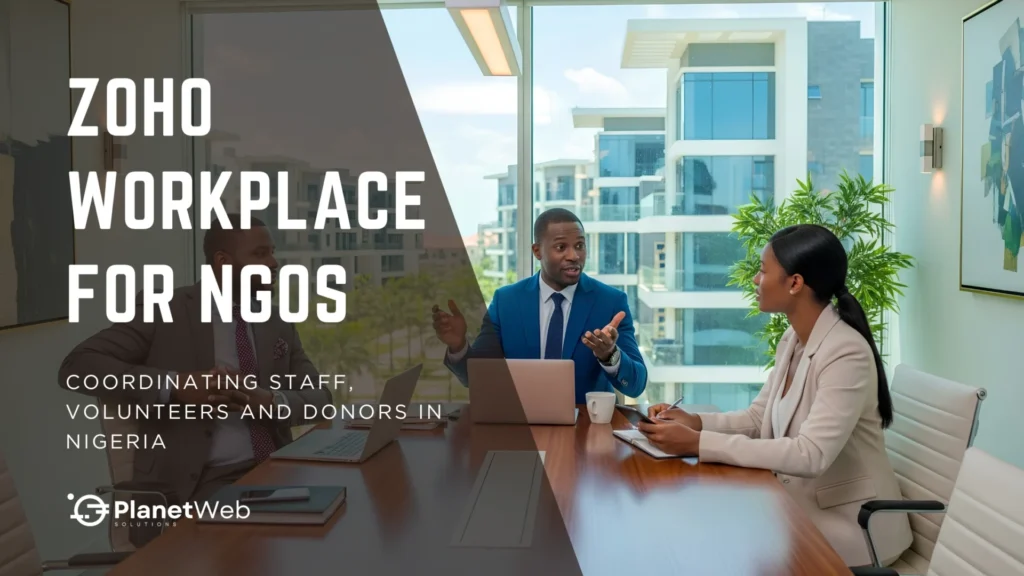
Zoho Workplace for NGOs: Built for Lean Organisations
Most businesses manage two primary groups of people: staff and customers. A Nigerian NGO running a real programme is managing staff, volunteers, donors, beneficiaries, partner organisations, and a board of trustees, often all at once, and most of them are not employees at all.
Every programme, campaign, or ongoing service creates its own working group of staff, volunteers, partners, and beneficiaries, one that keeps turning over even when the work itself, or the organisation running it, continues for years or decades.
That is a fundamentally different coordination problem than the one most collaboration tools, and most articles about them, are built to solve.
While some of what follows applies more broadly, the focus here is on programme-driven NGOs, whether founder-funded, donor-assisted, or grant-funded, where coordinating staff, volunteers, donors, beneficiaries, and partners around ongoing programmes of work creates a distinct set of operational demands.
This article makes the case for who Zoho Workplace fits among Nigerian NGOs (see Digital Tools for Nigerian NGOs: What to Use and Why for a broader tool comparison)., what it offers that Microsoft 365 and Google Workspace don’t for that segment, and where it stops being the right answer.
Why NGO Coordination Breaks Informal Systems Faster Than Most
Temporary Teams, Every Programme
Staff change roles. Volunteers rotate in and out within months. Partner organisations join for one project and leave when it ends. A consultant appears for a single deliverable and is gone.
Each of those people needs some level of access while they’re involved, and none of them fit neatly into the permanent-employee model most business software assumes.
Turnover Even in Ongoing Work
A scholarship round has an obvious start and end, while a continuous advocacy campaign or an ongoing outreach service doesn’t. Either way, the staff, volunteers, and partners involved still rotate through it, just against a reporting quarter or a financial year instead of a cycle’s close.
An organisation running for years or decades is effectively reconstituting its working group again and again, on top of whatever holds the organisation together day to day.
One version of this plays out constantly, cyclical or continuous: a board or funder asks for evidence that a specific training session or outreach visit happened eighteen months ago. The record was on a volunteer facilitator’s phone, and that volunteer’s involvement with the programme ended not long after. Nobody else ever saw it.
Reporting Built From Small Records
Reporting, whether to a board, a founder, or an occasional external donor, feels like a burden, but it doesn’t start as one. It starts on day one of a programme, as attendance sheets, approvals, receipts, photos, and forms accumulate one at a time.
By the time a report is due, someone has to reconstruct a narrative from records that were never organised with that report in mind.
Boards as a Distinct Stakeholder
A board approves budgets, strategy, and policy, and needs visibility into the organisation’s work without being staff, volunteers, or programme participants. That’s a fourth kind of stakeholder most collaboration tooling has no category for at all.
Running a mission-driven organisation does not reduce administration. It increases it, because the mission itself creates more relationships to coordinate, not fewer.
What Zoho Offers That Microsoft and Google Don’t
Limits of the Free Nonprofit Tier
Microsoft and Google both run genuine nonprofit programmes in Nigeria, verified through TechSoup Nigeria. That verification requires registered nonprofit status and takes time, and it only covers paid staff and unpaid executive leadership.
Volunteers get a separate, more limited offer. Programme participants, beneficiaries, donors, and trustees aren’t covered at all, which means the free tier was never designed around the exact stakeholder mix that defines NGO work.
Naira Pricing Beyond the Free Tier
For an organisation that doesn’t clear TechSoup verification, or needs paid access for the people the grants exclude, Microsoft 365 and Google Workspace revert to dollar-denominated commercial pricing. Zoho Pricing in Nigeria sets out what the naira-priced alternative costs instead.
No Dedicated IT Required
A large NGO can navigate nonprofit licence tiers and build custom workflow automation because it employs people whose job is exactly that. A five-person foundation coordinating volunteers, donors, and a board usually cannot.
Lower Operating Overhead
A lean NGO on Zoho Workplace has one admin console covering mail, files, and coordination across every stakeholder type, one vendor relationship, one renewal cycle.
An organisation patching together personal email accounts, a WhatsApp group for volunteers, and whatever storage happens to be free for programme records is running several systems that each need attention from someone whose actual job is running programmes, not managing IT.
Coverage the Free Grants Miss
Volunteers, programme participants, and partner organisations sit outside what Microsoft’s nonprofit licence was built to cover. Zoho’s per-user pricing means adding any of them to the platform is a straightforward licensing decision, not an exception to negotiate.
Built Around Structured Programme Work
A scholarship cycle and a health outreach campaign look nothing alike on the surface, but underneath they generate the same shape: intake, review or delivery, monitoring, and reporting, with a different mix of staff, volunteers, and beneficiaries responsible at each stage.
Take a training programme running across several communities. Facilitators need attendance and materials for their own sessions but nothing from the others. The monitoring officer needs a rollup across every session to report to the board or funder.
The programme lead needs to know which communities are behind schedule before the quarterly report is due, not after.
Although the work looks different, the underlying problem is the same. Different people are making decisions from different versions of the programme because no single system connects the stages together.
Zoho Flow for Nigerian Businesses covers how Flow connects Zoho’s apps into that kind of system, automating the handoffs between stages that would otherwise depend on someone remembering to update a spreadsheet.
What This Costs the Organisation
The Cost of Reporting Delays
A late or thin report is more than a passing annoyance to a board, a founder, or a funder. It becomes part of that relationship’s internal record of the organisation, and it can quietly weigh on the next funding or governance decision long before anyone says so directly.
Volunteer Turnover Without Institutional Memory
Every cohort of volunteers that leaves without a system to hold what they learned means the next cohort starts from the same beginning point. Over several cycles, that isn’t a one-off inconvenience; it’s capacity the organisation keeps paying for and never actually keeps.
Single-Person Partnership Risk
When a coalition relationship runs entirely through one staff member’s personal rapport, the organisation’s real institutional connection to that partner is thinner than it looks. If that person leaves, the partnership itself, well beyond their notes, may need rebuilding from scratch.
How the Tools Map to a Lean NGO
Zoho Mail replaces personal Gmail accounts with a proper organisational domain, so donor and partner correspondence stays with the NGO rather than in a departing volunteer’s personal inbox.
| Zoho Tool | What It Actually Changes for a Lean NGO |
|---|---|
| WorkDrive | Programme documentation lives in one version-controlled place instead of scattered personal drives, so nothing depends on one person’s laptop |
| Sheet | Applicant and beneficiary tracking happens in one shared, live record instead of a spreadsheet only one person can update |
| Flow | Status changes trigger the next step automatically instead of depending on someone remembering to follow up |
| Cliq | Coordination between staff and volunteers moves into a searchable, organisation-owned record instead of a WhatsApp group nobody can search |
| Admin Console | A departing volunteer or staff member’s access gets revoked in minutes instead of lingering indefinitely, without needing a dedicated IT hire |
Three Organisation Profiles, by Workflow Not Size
Each of these is a long-running institution with its own recurring version of the same pattern: staff, volunteers, partners, and beneficiaries assembling around each piece of work, cyclical or continuous, and needing tools configured around that reality rather than a generic one.
Scholarship or Award-Giving Foundation
A foundation running structured award cycles, whether funded by a founder, a family, or supplemented by occasional external donors, lives on applicant documentation, review coordination, and reporting across a rotating pool of volunteer reviewers.
WorkDrive organised by cohort, Sheet for tracking applications through review, and Flow connecting the two cover most of what this profile needs.
A reviewer who scored applicants for one cycle often isn’t involved in the next, and a foundation that can’t cleanly separate this year’s reviewer access from last year’s risks a former reviewer still holding opinions on applicants they have no current standing to assess.
Direct-Service Community Organisation
An organisation delivering health outreach, education support, or relief work directly needs field workers and volunteers coordinating in real time, often from outside a formal office and on unreliable connectivity, while still collecting evidence of what was actually delivered.
Cliq and Mail on mobile, with WorkDrive syncing beneficiary and evidence records once a connection is available, matter most here. A field visit that isn’t logged the same day it happens is rarely logged accurately a week later, once the details have blurred into every other visit that month.
Advocacy or Network Organisation
An advocacy group or a coalition of partner organisations runs on collaborative drafting: joint statements, policy submissions, and campaign materials that several organisations edit under time pressure before a deadline that doesn’t move.
WorkDrive’s version history and access controls matter most when coalition partners outside the organisation’s own domain are drafting the same document at once. A policy submission that goes out under several organisations’ names with one partner’s edits silently missing is a credibility problem, well beyond a formatting one.
Scaling Up: Zoho One and the Managed Support Decision
Growing Into Zoho One
An NGO that starts on Zoho Workplace for email, files, and coordination will eventually need more than those tools cover. More programmes, more donors, and financial reporting that has outgrown a spreadsheet are the usual signals.
Zoho One in Nigeria covers the upgrade path: CRM, finance, and project management added to the same licensing relationship the organisation already knows.
Building an Internal Team or Using Managed Support
Growth raises the same question it does in any lean organisation: who manages this as it gets more complex? Building an internal IT function is rarely justified at this size.
Managed IT Support in Nigeria sets out what a managed support arrangement should include. For most NGOs in this segment, it remains the more defensible choice well past the point where a director starts considering a full-time hire.
Where Zoho Loses
None of this is an argument that Zoho Workplace beats Microsoft or Google’s nonprofit programmes outright. A large NGO with confirmed TechSoup eligibility and dedicated IT staff has little reason to switch.
It likely also holds Microsoft’s Dynamics 365 nonprofit grants on top of its base licensing, giving it purpose-built donor and case management tooling Zoho isn’t trying to replace.
Some organisations also don’t get to choose. A major donor or funding agreement sometimes specifies the platform a grantee must use, usually Microsoft, as a condition of the funding itself, which makes the decision the funder’s rather than the NGO’s.
Zoho Workplace vs Microsoft 365: An Honest Comparison for Nigerian Businesses goes through that comparison directly for organisations weighing the two outside a funder mandate.
What Implementation Involves
Getting Zoho Workplace running is the easy part. The harder work happens before deployment: mapping how information should flow from programme to activity to report, and separately, how access should flow across partners, volunteers, and board members.
Board papers, committee minutes, and governance records usually need different access rules from programme documentation entirely, visible to trustees and senior staff, not the whole organisation, which is worth deciding deliberately rather than by default.
Getting that structure right takes input from whoever actually runs programmes day to day, not only whoever happens to be technically minded on staff. An access policy set without programme input rarely accounts for how volunteers and partners genuinely move through the organisation’s work.
For a small NGO, deployment typically takes two to four weeks from kickoff to full rollout. An organisation coordinating multiple programmes or partner relationships should expect six to eight weeks, with most of that time spent on planning rather than the technical setup itself.
Capacity Is the Real Constraint, Not Mission
Every programme, campaign, or ongoing service an NGO runs brings together a working group of staff, volunteers, partners, and beneficiaries that keeps turning over even inside an institution that has operated continuously for years or decades.
Most small and mid-sized Nigerian NGOs are managing that with tools built for a simpler relationship: one employer, one set of employees.
The organisations that close that gap now will be better positioned for every funding or governance report, every audit, and every partnership that depends on being able to produce a clean record on request.
Could Your Organisation Produce a Clean Record on Request?
Every document for any programme, cyclical or continuous. If that question makes you pause, a structured review of the organisation’s information environment is worth doing before a board, a founder, or a funder asks first. Learn more about our Zoho Solutions and Managed Support Services, or see our wider IT solutions for Nigerian non-profits, to see how we work with Nigerian NGOs.